
Definition: Hypothyroidism is characterized by low thyroid hormone production by the thyroid gland or the cell response to the thyroid hormone produced by the thyroid gland.
The thyroid gland is responsible for producing and releasing thyroid hormones.
Thyroid hormones are excreted by the thyroid gland and they should have biological effects on their target tissues like: increase metabolic rate, regulate protein synthesis, enhance mitochondrial activity, influence cardiovascular, gastroinstestinal, and neurological systems.
In simple terms:
Hypothyroidism either:
- Thyroid gland fails to produce enough thyroid hormone.
- The body’s cell fails to respond to thyroid hormones produced by the thyroid gland.
This means that there are different “flavors” of hypothyroidism which is key to understand so you can help your body heal.
Types of Hypothyroidism
Generally, hypothyroidism is divided into two categories: Primary VS Secondary Hypothyroidism. These are the two “recognized” types of hypothyroidism. There are other types of hypothyroidism that are not recognized like cellular hypothyroidism or thyroid hormone resistance.
Primary Hypothyroidism
Primary hypothyroidism refers to a malfunction of the thyroid gland. Think of it like a hardware problem.
These are the steps of thyroid hormone production (thyroid hormone synthesis).
- Iodide Trapping
- Oxidation and Organification
- Coupling Reaction
- Storage in Colloid
- Secretion

Iodide Trapping
Iodide is transported from the bloodstream into the thyroid gland via the sodium-iodide symporter.
Oxidation and Organification
Iodide is oxidized to iodine by the enzyme Thyroid Peroxidase (TPO)
Iodine is then attached to the amino acid tyrosine, which is part of a bigger protein called thyroglobulin. This creates two building blocks:
- One iodine makes monoiodotyrosine (MIT) – “one iodine attached to tyrosine”
- Two iodine makes diiodotyrosine (DIT) – “two iodines attached to tyrosine”
Coupling reaction
Two DITs comine to build the thyroid hormone T4 (Thyroxine)
One MIT + one DIT come to build the hormone T3 (Triiodothyronine)
Storage in Colloid
Thyroid follicles are the cells responsible for all of these processes. Here’s a visual to help you understand this.
Follicular Cell – The outer layer of the cell
Lumen – The empty space inside the cell
Colloid – A jelly-like material that fills the lumen made up mostly of the protein called thyroglobulin, which holds the building blocks of thyroid hormones T3 or T4.

The thyroid follicle is where the thyroid stores its hormone precursors (the iodinated thyroglobulin containing T3 and T4.) It’s like a warehouse filled with supplies (iodinated thyroglobulin – MIT and DIT) waiting to be assembled into the thyroid hormones T3 and T4.
When the body signals the thyroid via TSH, the follicular cells take this stored iodinated thyroglobulin, process it, and release T3 and T4 into the bloodstream.
Secretion
Here’s a summary of how the thyroid gland secretes thyroid hormones:
- TSH signals the thyroid to release T3 and T4.
- T3 and T4 are stored in the thyroid follicular cells (outer layer).
- Follicular cells pull some of the stored thyroglobulin from the colloid.
- Thyroglobulin is then broken down to release the free T3 and T4
- These free hormones are then secreted into the bloodstream.

Secondary Hypothyroidism
Secondary Hypothyroidism means that the thyroid is functioning properly, but the pituitary gland doesn’t produce enough Thyroid Stimulating Hormone (TSH). This is found when TSH levels are low, which distinguishes it from primary hypothyroidism where TSH levels are high.
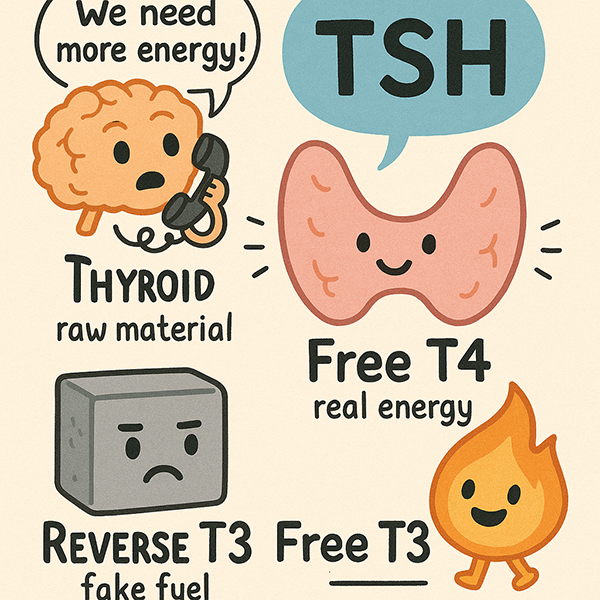
TSH is like a special phone call that the pituitary gland makes to the thyroid directing it to produce more thyroid hormone.
Low TSH means that the pituitary gland is not signaling the thyroid as much as it should…
Compare that to primary Hypothyroidism where the pituitary gland is signaling the thyroid, but the thyroid does not repond or there is not enough free T3 and free T4 in the system so the pituitary gland increases its signaling to the thyroid directing it to produce more hormones.
Cellular Hypothyroidism
If secondary hypothyroidism is upstream from thyroid function, then cellular hypothyroidism is downstream from thyroid function… cellular hypothyroidism means that the pituitary gland has signaled the the thyroid properly (shown by normal TSH levels). The thyroid has then produced enough thyroid hormone T4 and T3.
The breakdown then happens if the target cells fail to respond to the thyroid hormones produced. There’s a few reasons why this could happen:
- Cells are unable to uptake the thyroid hormone T3/T4
- The thyroid hormone T4 is unable to be converted into Free T3 (makes reverse T3 instead)
- Inflammation or oxidative stress disrupting thyroid hormone action
This type of hypothyroidism is popular with naturopaths, integrative or functional medicine, but not established in conventional endocrinology.


